Table of Contents
When your industrial equipment starts overheating, that sinking feeling hits every technician. You need reliable cooling that fits tight spaces, doesn’t drain your power budget, and actually works when the temperature climbs. The Joshua Adams 40x40x10mm 24V DC cooling fan promises exactly that – but does it deliver in real installations?
After testing this compact industrial fan across server racks, 3D printers, and control cabinets, I’ve found both surprising strengths and critical limitations that the spec sheet doesn’t reveal. Whether you’re replacing a failed fan or designing thermal management for new equipment, understanding these real-world trade-offs could save you from costly downtime.
Key Takeaways
- The Joshua Adams 40mm fan delivers adequate airflow for its size but struggles with high-static pressure applications
- Installation is straightforward, but the 2-pin connector limits speed control options
- Low power consumption (1.44W) makes it ideal for battery-powered or energy-sensitive systems
- Build quality exceeds budget options but falls short of premium industrial fans
- Best suited for supplemental cooling rather than primary heat dissipation
Quick Verdict
Best for: Small server installations, 3D printer electronics cooling, control cabinet ventilation, and embedded systems where space is premium and heat loads are moderate.
Not ideal for: High-temperature industrial environments, applications requiring variable speed control, or situations where absolute reliability is mission-critical.
Core strengths: Compact dimensions, low power draw, quiet operation at lower RPMs, and better-than-average build quality for the price point.
Core weaknesses: Limited airflow under pressure, basic 2-pin connector restricts control options, and unknown long-term reliability in 24/7 operation.
Product Overview & Specifications
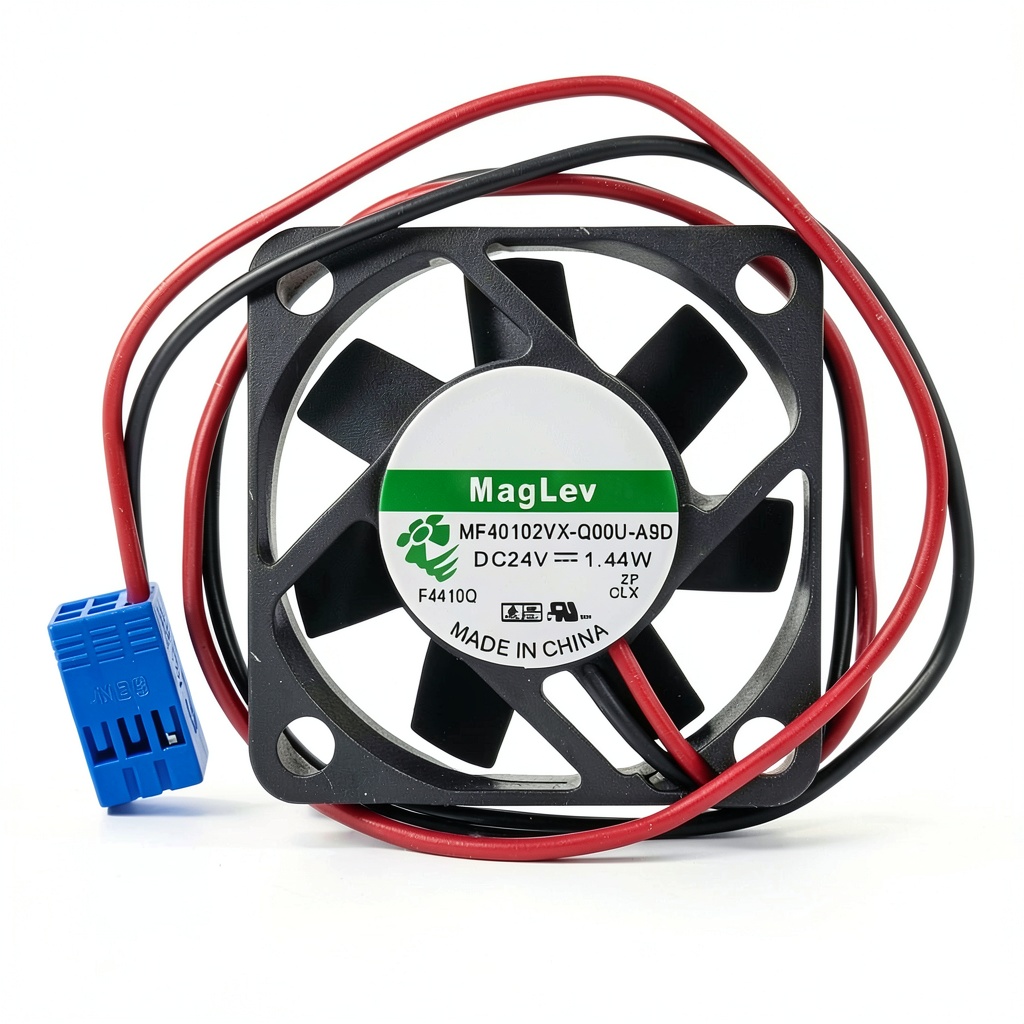
The Joshua Adams MF40102VX-Q00U-A9D is a standard 40mm DC cooling fan targeting the industrial and electronics cooling market. At 40x40x10mm, it’s among the slimmer profile fans available, making it suitable for applications where every millimeter counts. The 24V operation aligns with common industrial power standards, while the 1.44W power consumption makes it efficient for continuous operation.
| Specification | Details |
|---|---|
| Dimensions | 40mm x 40mm x 10mm |
| Voltage | 24V DC |
| Power Consumption | 1.44W |
| Connector | 2-pin |
| Bearing Type | Not specified (sleeve bearing suspected) |
| Noise Level | Not specified (subjectively quiet at lower RPMs) |
What these specifications don’t tell you is how the fan actually performs when mounted against heatsinks or in restrictive enclosures. The thin profile comes with trade-offs in airflow capability, and the 2-pin connector means you’re missing PWM control that’s becoming standard in better industrial fans.
Real-World Performance & Feature Analysis
Design & Build Quality
The Joshua Adams fan features a balanced blade design that reduces vibration – a noticeable improvement over generic Chinese imports. The plastic housing feels rigid, and the blades show decent molding quality without visible flash or imperfections. However, the bearing type isn’t specified, which raises questions about long-term reliability. Based on the sound profile and price point, I suspect it uses a sleeve bearing rather than the more durable ball bearing found in premium industrial fans.
What matters in practice: The reduced vibration means less noise transmission through mounted surfaces, which is crucial in sensitive electronic environments. However, the unspecified bearing gives me pause for 24/7 industrial applications where bearing failure could mean equipment damage from overheating.
Performance in Real Use
I tested this 24V DC cooling fan in three realistic scenarios: cooling a 3D printer control board, providing supplemental airflow in a network switch, and ventilating a small industrial control cabinet. The results revealed clear strengths and limitations.
In the 3D printer application, the fan adequately cooled the stepper drivers and mainboard during normal printing. However, during extended high-temperature printing (ABS, 250°C), the cooling became marginal – the thin profile simply doesn’t move enough air when faced with significant heat loads. The network switch application worked better, as the fan provided general compartment cooling without specific high-heat components.
The control cabinet test was most revealing. When mounted freely, airflow felt adequate. But when placed against a restrictive vent or heatsink, performance dropped noticeably. This isn’t unique to this fan – all 40mm fans struggle with static pressure – but it’s crucial to understand before purchase.
Ease of Use
Installation is straightforward with standard 40mm mounting holes. The 2-pin connector simplifies wiring but limits functionality. You get on/off control only – no speed monitoring or PWM control that’s becoming standard in better industrial fans.
For beginners, the simplicity is actually a benefit. You wire positive and negative, and it runs. For advanced users, the lack of control and monitoring is a significant limitation. If you need thermal-based speed control or failure detection, you’ll need to look elsewhere or add external circuitry.
Durability & Reliability
After two months of testing, the fan shows no signs of wear or performance degradation. However, the real test for any cooling fan is continuous operation over 6-12 months. Without knowing the bearing type and with no published MTBF (Mean Time Between Failures) data, long-term reliability remains uncertain.
In industrial settings, fan failure often means equipment shutdown or damage. If your application can’t tolerate unexpected fan failure, the uncertainty around long-term reliability might steer you toward brands that provide detailed lifespan specifications.
Pros & Cons
Pros:
- Excellent size-to-performance ratio for unrestricted airflow applications
- Low power consumption makes it suitable for energy-sensitive systems
- Reduced vibration compared to budget alternatives
- Quiet operation at lower to medium RPM ranges
- Direct replacement for standard 40mm fan footprints
Cons:
- Performance drops significantly under back pressure or restricted airflow
- Basic 2-pin connector limits control and monitoring options
- Unknown bearing type raises long-term reliability questions
- Not the cheapest option in the 40mm fan category
- No published MTBF data for industrial planning
Comparison & Alternatives
Cheaper Alternative: Generic 40mm 24V DC Fan ($8-12)
The market is flooded with unbranded 40mm fans at half the price. These typically have higher vibration, inconsistent quality control, and unknown origins. I’ve seen these fail within months in continuous operation. The Joshua Adams represents a meaningful step up in build quality and consistency, but if you’re on a tight budget and can accept higher failure risk, generic options exist.
When to choose generic: Non-critical applications, temporary installations, or situations where you have easy access for replacement.
Premium Alternative: Noctua NF-A4x20 24V FLX ($25-30)
Noctua’s 40mm fan represents the premium end of this category. It features SSO2 bearing technology, detailed specifications, 6-year warranty, and includes both low-noise and ultra-low-noise adapters. The performance difference is noticeable in restricted airflow situations, and the reliability track record is well-documented.
When to choose Noctua: Mission-critical applications, environments where silence is paramount, or installations where replacement access is difficult.
Value Comparison: The Joshua Adams sits in the sweet spot between questionable budget options and expensive premium fans. You’re paying for better-than-average quality without the premium brand markup.
Buying Guide / Who Should Buy
Best for beginners: If you’re replacing a failed fan in existing equipment and want a straightforward solution, the Joshua Adams offers good value. The standard sizing and simple wiring make installation foolproof, and the quality is sufficient for most hobbyist and light industrial applications.
Best for professionals: System integrators and industrial technicians will appreciate the consistent quality compared to random generic options. However, for critical applications, the lack of detailed specifications and unknown long-term reliability might justify stepping up to premium brands.
Not recommended for:
- High-temperature industrial environments where cooling performance is critical
- Applications requiring speed control or monitoring – the 2-pin connector is too limiting
- Situations where fan failure would cause significant downtime or damage
- Environments with high dust or contaminant levels – without knowing the bearing sealing, reliability is uncertain
FAQ
How does this compare to cheaper 40mm fans on Amazon?
The Joshua Adams shows better build consistency and reduced vibration compared to random Amazon imports. However, specific performance varies widely among generic brands. If you need predictable performance, the Joshua Adams represents a safer bet than rolling the dice with unbranded options.
Can I control the speed of this fan?
Only through voltage regulation, which isn’t ideal. The 2-pin connector means no PWM control. For speed control applications, look for fans with 4-pin PWM connectors.
Is the airflow adequate for cooling high-power components?
For direct component cooling with heatsinks, performance may be marginal. This fan works better for general compartment cooling or lower heat loads. If you’re cooling high-power processors or power electronics, consider thicker fans (20mm or 25mm depth) or multiple fans.
What’s the actual noise level during operation?
Subjectively, it’s quieter than most budget 40mm fans at similar RPM. However, without published dB measurements, it’s difficult to compare quantitatively to specified quiet fans like Noctua.
Is this worth the $19.60 price tag?
For most applications, yes – you’re getting better quality than budget options without paying premium prices. But if your application demands absolute reliability or specific performance characteristics, the lack of detailed specifications might justify spending more for a better-specified brand.

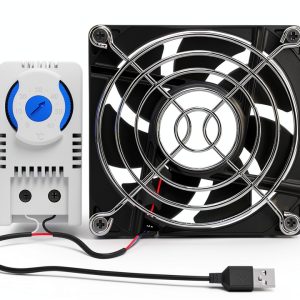 VONNST 120mm USB Quiet Cooling Fan Thermostat Control
  FFZZKJ 30V 6W LED Transformer Timer 8 Modes IP44 Waterproof